8 SEO Trends for 2026: A Complete Guide to Staying Ahead in Search Rankings
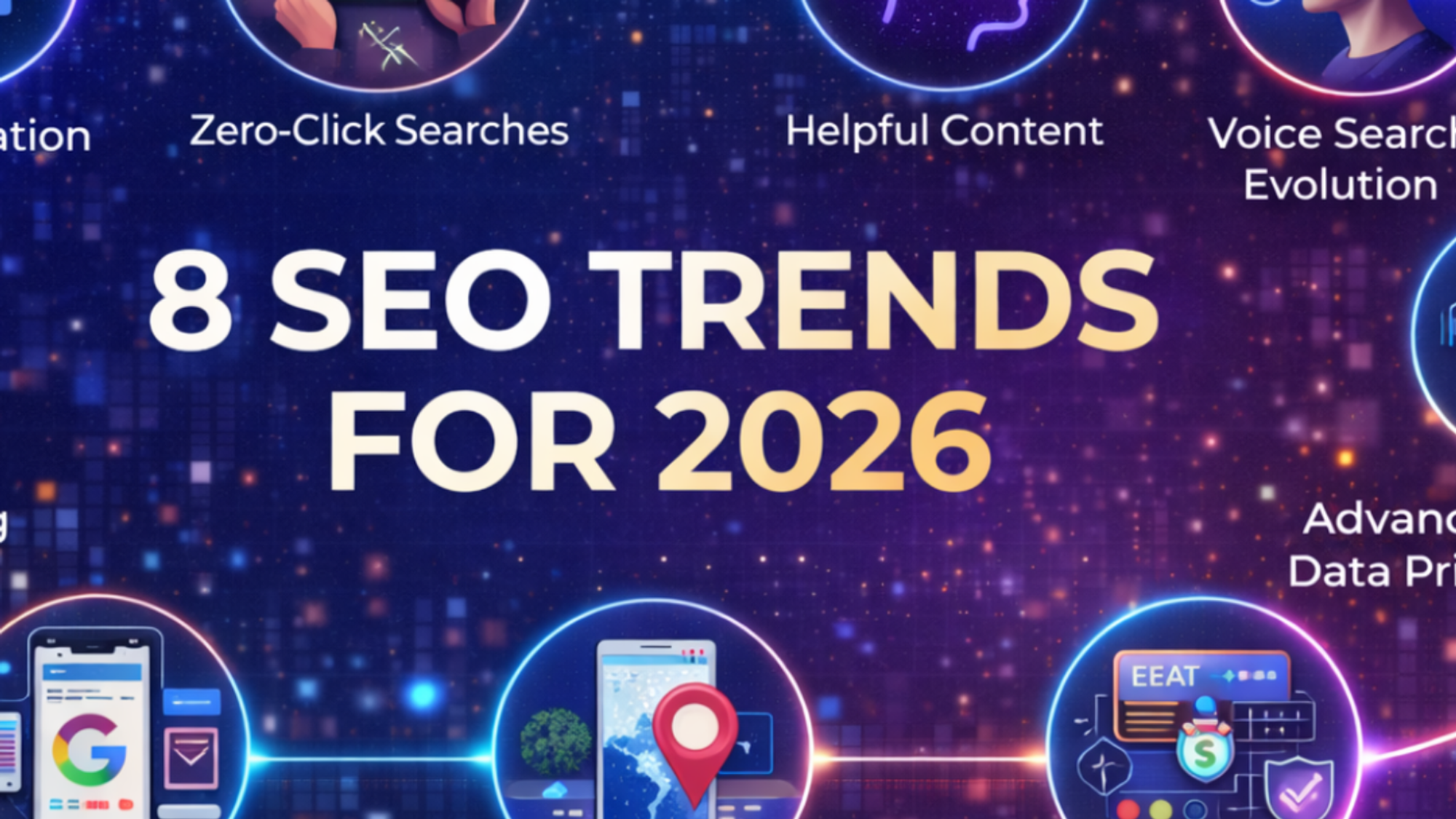
8 SEO Trends for 2026
Here's a number that should change how you think about your website. Between January and April 2026, 68% of Google searches in the US ended without a single click, according to SparkToro's clickstream analysis. Two years earlier that figure was 58.5%. The searches are still happening. The clicks are disappearing.
That's the backdrop for every conversation about SEO trends right now. Most small businesses are still running a playbook built for a Google that showed ten blue links and sent you the traffic. That Google is gone. In its place is a search engine that answers the question itself, cites a handful of sources, and only occasionally sends someone through to your site.
The good news? The businesses that adapt are winning bigger than ever. AI-referred visitors convert 31% better than traditional search visitors, according to Search Engine Land's 2027 priorities report. Fewer clicks, better clicks.
This guide breaks down the 8 SEO trends that will define 2027, backed by 2026 data rather than guesswork. For each one, you'll get the trend, the evidence, and the specific move to make. Let's get into it.
What Changed in 2026 (and Why It Rewrites the SEO Trends List)
You can't plan for 2027 without understanding what actually happened this year. And a lot happened.
AI Mode hit 1 billion users and AI Overviews hit 2.5 billion
At Google I/O in May 2026, the company confirmed that AI Mode passed 1 billion monthly users in its first year, with query volume doubling every quarter. AI Overviews, the summaries that sit above the traditional results, now reach 2.5 billion people a month. Gemini 3.5 Flash became the default model behind AI Mode, and Google called the redesigned search box "the biggest upgrade to the Search box in over 25 years," as Search Engine Journal reported.
The behavior shift matters more than the headline numbers. People using AI Mode type queries three times longer than traditional searches and ask 40% more follow-up questions month over month. Search stopped being a keyword and became a conversation.
Two core updates, one new Search Console report
Google shipped core updates in March and May 2026, and both hit thin, generic content hard. We covered the fallout in our breakdown of the Google Core Update March 2026. Then in June, Google launched a dedicated AI search performance report inside Search Console. For the first time, you can see how often your pages appear in AI features. We explained exactly what it shows and what it doesn't in our guide to AI search visibility.
Put those three things together and you get the story of 2026: AI became the front door to search, Google raised the quality bar, and it finally gave us a way to measure the new game.
8 SEO Trends That Will Shape 2027
Now for the trends themselves. These aren't predictions pulled from thin air. Each one is already showing up in the data.
1. AI Overviews and AI Mode become the default search experience
Of all the SEO trends on this list, this is the one that drives the others. AI Overviews already appear on more than 20% of Google searches, and when they show up, click-through rates on the traditional results drop by nearly 60%, according to SparkToro's analysis. By 2027, expect AI answers on the majority of informational queries.
Getting cited inside those answers is now its own discipline. Some people call it generative engine optimization, and we compared the two approaches in our post on SEO vs GEO. The short version: AI systems pull from pages that answer a specific question clearly, early, and with evidence.
What to do: Open every key page with a direct, two-sentence answer to the question the page targets. Then support it with data. Google's own guidance at I/O was refreshingly plain: focus on what visitors need, and don't bother with llms.txt files, because they aren't required for AI visibility.
2. Zero-click search forces a rethink of what "traffic" means
The 68% zero-click figure isn't a blip. It rose 7.5 percentage points in two years while searches that generate a click fell almost 23%. Nearly one in three searches now leads to another Google search instead of a website.
Here's the thing most people miss. Zero-click doesn't mean zero value. If your business name and your answer appear in the AI Overview for "best accountant for restaurants in Denton," you've won that impression even if nobody clicks. Brand recall drives the direct visit, the phone call, and the "I saw you on Google" moment two weeks later.
What to do: Track impressions and branded search growth alongside clicks. Structure your content so the key takeaway is visible in the snippet, and make your brand name part of the answer, not just the URL.
3. Brand mentions start to outweigh backlinks
This is the SEO trend that surprised the most veterans. Ahrefs analyzed 75,000 brands and found that unlinked brand mentions across the web correlate with AI visibility at 0.664, while backlinks correlate at just 0.218. YouTube mentions scored highest of all at 0.737.
Translation? Getting talked about now beats getting linked to. AI models learn who you are from the whole web, not from a link graph. A podcast appearance, a Reddit thread, a YouTube review, a local news mention: all of it teaches the model that your brand exists and what it's known for.
What to do: Shift a portion of your link-building budget into PR, partnerships, and content that earns conversation. Make sure your brand name appears consistently, spelled the same way, everywhere you show up.
4. E-E-A-T moves from advice to requirement
Experience, expertise, authoritativeness, and trustworthiness used to be a "nice to have" for most small business sites. After the December 2025 and 2026 core updates, it's the price of admission. HubSpot's analysis found sites with strong E-E-A-T signals gained 23% in traffic after the December update while generic content farms fell off a cliff. Even more telling: pages ranked in positions 6 through 10 with strong authority were cited 2.3 times more often in AI answers than pages ranked #1 with weak signals.
Ranking first no longer guarantees the citation. Trust does.
What to do: Put a real author with real credentials on every post. Add a bio, a photo, and a visible "last updated" date. Cite your sources inline. If you're unsure where you stand, start with our plain-English E-E-A-T guide.
5. Topic depth beats content volume
Publishing three shallow posts a week worked in 2019. Now it's a liability. Both AI systems and Google's core updates reward sites that cover a subject completely, with pillar pages and supporting articles that link to each other
Think of it this way. If you're a plumber in Texas and you have one 400-word post on water heaters, you're invisible. If you have a complete guide plus articles on tankless vs tank, repair vs replace, permit rules, and cost ranges, all interlinked, you've built something an AI model recognizes as an authority.
What to do: Pick the three topics your business needs to own. Build one deep guide for each, then add supporting posts that answer the follow-up questions. Prune or merge the thin content you already have. This is one of the SEO trends where doing less, better, is the whole strategy.
6. Search goes multimodal: visual, video, and voice as one trend
Over 16% of Google searches now use multimodal input, meaning voice, images, or video, according to Google's I/O 2026 data. That's a big change from a few years ago when "voice search is the future" was mostly hype. Voice hasn't taken over, but it's become one input among several, and people expect to snap a photo or talk to their phone and get a useful answer.
Video matters even more. YouTube is the second most visited site on earth, YouTube mentions are the strongest predictor of AI visibility in the Ahrefs data, and Google surfaces video results directly in AI Overviews.
What to do: Add descriptive alt text and captions to every image. Publish short explainer videos for your top-performing topics and embed them on the matching page. Write headings as natural questions so conversational queries match your content.
7. Technical SEO becomes AI readability
Core Web Vitals still count, and the metrics changed. Interaction to Next Paint (INP) replaced First Input Delay in 2024, and a lot of sites are still measuring the old number. Our Core Web Vitals guide explains all three current metrics in plain English.
But the bigger technical shift is about readability for machines. AI crawlers need clean HTML, proper heading hierarchy, and structured data to understand what a page is about. A page that renders beautifully for humans but hides its content behind JavaScript is a page the AI skips. Google has expanded its structured data guidance repeatedly through 2026 for exactly this reason.
What to do: Run a Core Web Vitals check and fix INP first. Add Article, FAQ, and Organization schema. Make sure every page has one H1, logical H2s and H3s, and content that's visible in the raw HTML. Our post on why website speed matters covers the performance side in detail.
8. Multi-platform discovery: YouTube, Reddit, TikTok, and LLMs
Google is still the biggest door, but it's no longer the only one. Similarweb data cited by HubSpot shows 35% of US consumers now use AI tools for product discovery, and consumers bounce across an average of 3.6 platforms before buying. Among Gen Z, 49% use TikTok to find products. In B2B, vendor discovery splits almost evenly three ways: web search, peer recommendations, and AI chatbots.
The lesson for SEO trends in 2027: your "search" strategy has to include the places people search that aren't Google. ChatGPT, Perplexity, Reddit, YouTube, and TikTok are all search engines now.
What to do: Make sure your business is described accurately and consistently on Reddit, review sites, and industry directories. Repurpose your best blog content into a short video and a social post. And test what ChatGPT and Perplexity say when someone asks about your category in your city. If you're not mentioned, that's your next project.
Is SEO Dead in 2027, or Just Different?
Every year someone declares SEO dead, and every year the SEO trends prove them half right. This year they've got better ammunition than usual. So let's look at it honestly.
What the click data actually says
SparkToro's headline finding is that less than a third of Google searches now send a click to the open web. That's real, and it's not reversing. But the same data shows total search volume is still growing, AI Mode queries are doubling quarterly, and AI-referred visitors convert 31% better than traditional organic visitors.
SEO didn't die. The lazy version of SEO died. The version where you publish keyword-matched articles and collect traffic on autopilot is over. The version where you build a recognizable, trusted brand that shows up wherever people ask questions is more valuable than ever.
Where the ROI moved
The return shifted from volume to quality. Fewer visitors, but visitors who already read the AI summary, already know your name, and arrive ready to act. For a small business, that's a better deal than 10,000 bounces from a listicle. If you're weighing organic against paid, our comparison of SEO vs PPC walks through the numbers.
How Do Small Businesses Keep Up With SEO Trends Without a Big Budget?
You don't need an enterprise budget. You need focus. Most of what's on this list rewards doing a few things well over doing everything badly.
The 5 moves that matter most
- Answer first. Rewrite the opening of your top 10 pages so the direct answer is in the first two sentences.
- Show your people. Add author bios with credentials to every post and a real "About" page with names and faces.
- Go deep on three topics. Build one pillar guide per topic and link the supporting posts to it.
- Fix INP and schema. One technical afternoon covers most of trend 7.
- Earn mentions. One local news feature, one podcast, one YouTube review. Repeat quarterly.
If that list feels like more than your team can take on, that's exactly the gap our SEO services are built to close. We handle the technical and content side so you can run your business.
What to stop doing
Stop publishing for volume. Stop buying links. Stop tracking rankings as your only metric. And stop rewriting the same generic "trends" post every year without adding anything new. (Yes, we're aware of the irony. That's why this one has sources.)
How Do You Measure SEO Success When Clicks Are Falling?
If clicks are the only thing on your dashboard, 2027 is going to look like failure even when it isn't. The measurement stack needs to change with the SEO trends.
The new Search Console AI report
Google's AI search performance report, launched in June 2026, shows impressions in AI Overviews and AI Mode broken down by page, country, and device. It doesn't show clicks or click-through rate, which is frustrating, but it does show whether you're in the conversation at all. Check it monthly and watch which pages earn AI impressions. Those are your templates for the SEO trends ahead.
Metrics beyond clicks
- Branded search volume. If more people search your business name, your visibility is working even when clicks are flat.
- AI citations. Ask ChatGPT, Perplexity, and Google AI Mode the questions your customers ask. Log whether you're cited.
- Conversion rate by source. AI referrals convert better. Make sure your analytics separates them.
- Direct traffic and calls. The zero-click visitor often shows up as a direct visit or a phone call days later.
Final Thoughts
Three things to take from all of this. Visibility now matters more than rankings, because being cited in an AI answer beats sitting at position 3 under it. Authority matters more than volume, because both Google and AI models reward depth and trust over output. And brand matters more than backlinks, because the web is learning who you are from every mention, not just every link.
The SEO trends shaping 2027 reward businesses that act like experts and get talked about. That's a strategy any small business can run, and the ones that start now will own their category by the time everyone else catches up.
Ready to future-proof your search visibility? Book a free consultation with Bytes Platform and we'll map out exactly which of these 8 trends to tackle first for your business.